Your Cost Per Acquisition Just Went from $40 to $120. What the Eff Happened?
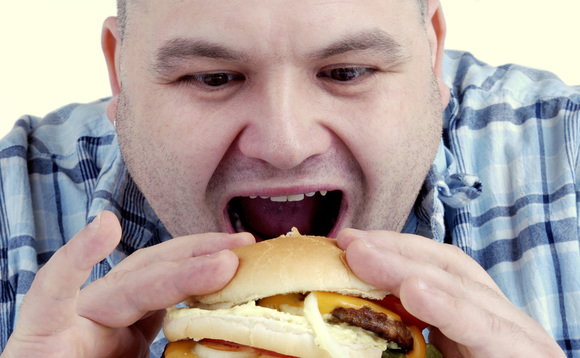
Image credit: channelweb.co.uk
“Say you set up a burger stand on the street and are allowed to pick one advantage that will be denied to your competitors. What would you choose to ensure your business thrives?”
Think about it for a moment and write down your answer. What did you choose?
That was the question the late, great direct response marketing guru Gary Halbert often posed to his students. They invariably picked things like fresher or thicker patties, organic beef, gourmet ketchup, freshly baked buns with sesame seeds, and so on.
Not known for his humility, Gary would arrogantly declare “I put it to you that whatever you pick, my one advantage will beat all of yours!”
And of course he’d be right. To generate the millions in sales his campaigns usually did, he had to be right a lot. Want to know what his one advantage was?
Drum roll please…It was “a starving crowd”
It is so basic, yet so important--and also so easy to forget when scaling marketing campaigns. To channel Winston Churchill, never in the field of direct-to-consumer marketing has so much been spent, by so many venture-backed startups, for so little profit :)
The typical pattern we see is this:
-
Company A starts marketing a CPG (consumer packaged goods) product and initially has a decent CPA (Cost Per Acquisition), say $40 for the initial sale. Viola! We’ve cracked product-market fit and customer acquisition, they think. Investors are pleased.
-
They make long term projections based on this number, maybe even raise more capital and start to scale aggressively.
-
Before long, they notice that the CPA is closer to $120 because the conversion rate dropped from 2.5% to less than 1%. The crowd isn’t so hungry anymore, and with the expected Customer Lifetime Value being barely above the CPA, the path to profitability is elusive!
What happened? This is usually when we get called in, as CRO (Conversion Rate Optimization) experts. Below are common reasons why the crowd now appears sated, despite your sizzling grass-fed organic patties!
Your Targeting is Much broader so the Conversion Rate is Lower
You’ve exhausted the early adopters and enthusiasts in your space, and are now trying to convert a mainstream audience that moves more slowly. They likely need many more exposures to your product before they buy, contributing to the higher CPA as you rack up those impressions and clicks--and enrich Google and Facebook. The innovation adoption lifecycle popularized by Geoffrey Moore in Crossing the Chasm, partially explains this.
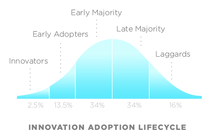
Andrew Chen has also talked about it here:
In Google Adwords campaigns, you will see the CPA rise whenever you go from exact match to broad match, and then to general display advertising.
The Organic Traffic from the Splashy Launch is Gone
You launched with a huge media splash and got mentions in TechCrunch, New York Times, Forbes etc that resulted in lots of “free traffic” (or earned media) initially. Friends, family and social media contacts may also have bought during the initial wave. All this contributed to a lower blended CPA that obscured your actual CPA. We are seeing this with one of our current clients in the health CPG space.
Intense Competition and Saturation:
You found a hot new niche that has attracted lots of well funded entrants competing for the same customers. Examples of this include daily deals sites like Groupon, Living Social and Zulily in 2010, Acai Berry Weight Loss Offers in 2007 to 2009 and food delivery currently (Doordash, Postmates, UberEats).
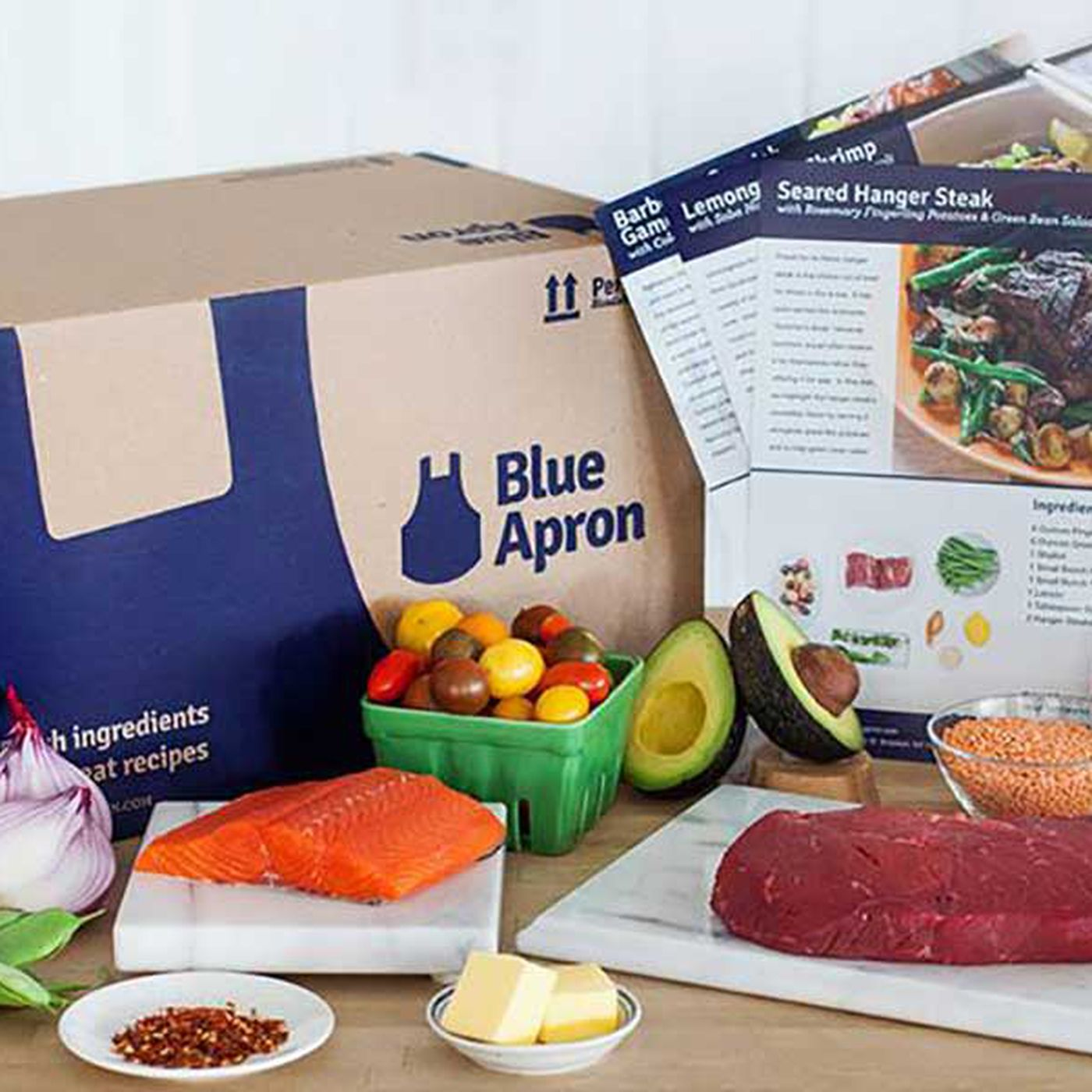
Another once hot niche that exhibited this behavior is meal kits, with companies like Blue Apron, Freshly and Munchery fighting to the death. Eventually the target audiences start tuning out the ads as they have had their fill of burgers--or in the case of Freshly, the three bean chilli that tastes like it has been freeze dried in a bunker for years :) Munchery shut down and Blue Apron lost almost 90% of its value but Covid-19 seems to have helped it as more people stay in and prepare their own meals.
The “60 Minutes” Effect
There has been some kind of exposé about the shenanigans in your industry on national shows like CBS’s 60 Minutes or NBC’s Dateline, and now the general public is wary of your product. This happened to brain training apps like Lumosity, after the FTC cracked down on them for false advertising.
SmileDirectClub fell victim to this effect and is now suing NBC for $3 Billion in damages. According to the Wall Street Journal:
SmileDirectClub’s complaint claims that the reports from NBC News contained numerous errors involving the safety and effectiveness of its products, and that the network knew its stories about SmileDirectClub were untruthful.
SmileDirectClub said its market capitalization fell by more than $950 million after the report was aired and that prospective customers canceled their treatments. Its market capitalization currently stands at about $2.63 billion. The company went public in September at $23 a share. On Monday, the stock closed at $6.76.
What are the solutions? Like families, all happy companies are alike but each unhappy one is unhappy in its own way :) The solutions will therefore be highly situational. Here are some general approaches that you should consider.
-
Wean Your Company off Paid Traffic and Look for Virality Opportunities
Andrew Chen talks about this in one of his essays, citing DropBox. When Dropbox tried to use Google Adwords, the CPA for a new user was above $200! As most users never upgraded from the free tier to a paid plan, this would never have worked. So they hit on the brilliant referral strategy. Refer friends and get extra storage. Today, Dropbox is worth about $10 billion and much of this valuation can be traced back to the referral acquisition strategy.
Notice how situational this is. Refer friends and get free stuff works for file storage but not for most other products. Thousands of sites have “refer a friend” links (usually for some kind of discount) that are mostly ignored. It isn’t socially acceptable to blast your social media pages with referral links to get a discount on products, but it is fine for file storage.
OkCupid (the popular free dating site gobbled up by Match.com) could also not afford paid acquisition and used a ‘quasi viral’ strategy to acquire users. They invested heavily in content that went wildy viral. According to Traction by Gabriel Weinberg, each post took a month to write--they sliced and diced the data from their initial set of users and told interesting stories, while irreverently poking fun at paid dating sites i.e. the men on paid dating sites are unwittingly engaged in a form of indentured servitude :) [the post has since been taken down by Match.com]
-
Sell an Information Product to Defray You Main Product’s Cost of Acquisition
This works especially well for software and is the reason ClickFunnels is doing $100 million in annual revenue without ever having raised a single dollar of venture capital! According to the founder Russell Brunson, when the company started succeeding, Venture Capitalists would approach him to discuss investing. They would invariably ask about the CPA.
“We have a negative CPA” he’d respond. “We make $20 on each customer acquisition!”
They were dumbfounded as this did not jibe with their model of the world! But it was true, because he sold the software as a 1-click upsell on the back of a high margin information product.
There’s also another crucial point about this. The universe of people who want to learn about a topic (and are willing to spend a few dollars to learn how) is larger than those who will pay a recurring fee for a software product. If you sell your product directly, the CPA will be a lot higher than if you sell it on the back of an info product. Russell has two front-end info-product offers, Expert Secrets (monetize your know-how) and Traffic Secrets (learn how to get traffic).
But it takes considerable skill at copywriting to sell an info product. I’ve seen a lot of people give away their books for free, not out of the kindness of their hearts, but because they couldn’t master the skill of selling. Some then complain that those who are successful at selling are grifting and “selling what can be found anywhere for free!”
-
Accept that the Opportunity is Smaller than initially Thought and Restructure Your Business Accordingly
There are lots of successful businesses humming along quietly and generating fantastic high six-figure and seven-figure incomes for their owners, that will never become ‘unicorns’. Resist the urge to raise more capital and “put money to work” when the market simply won’t bear it. When Fab.com failed, one of the employees explained that it was because investors tried to wring a $1 billion exit out of what should have stayed a $100 million (max) affair.
-
Get Big Fast, So You Can Attain Economies of Scale
If you are in the CPG (Consumer Packaged Goods) industry, this can work. For instance, a small or midsize supplement company that markets protein powder can reduce their cost per unit by sourcing in the hundreds of thousands of units vs. tens of thousands. If the product is re-ordered frequently, it may make sense to incur debt to fuel rapid growth, to attain economies of scale. MusclePharm did this effectively.
-
Invest In CRO (Conversion Rate Optimization)
Anyone can run an A/B test to randomly test various funnel elements, but it takes a lot of hard work and skill to meaningfully and sustainably increase a business’s conversion rate. About 1 in 8 tests attain statistical significance and even fewer get a positive lift. Having access to a large library of tests can dramatically improve your success rate, and even small gains quickly compound--giving you a decisive advantage!
For example, to get a 100% lift (2x) in conversion rate you need only get a 19% lift at four points in your funnel.
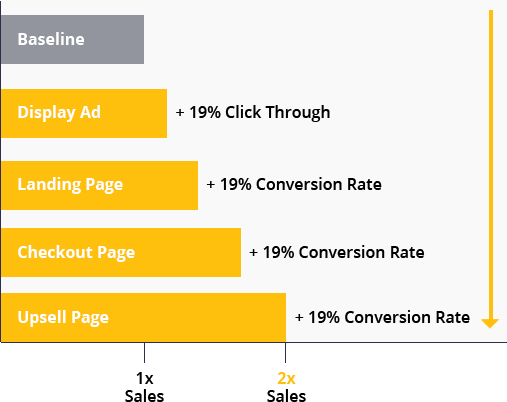
The cumulative effect of getting a 19% Conversion Rate lift at 4 points in your customer acquisition funnel. Leads to 100% more sales (2x)
The most under-optimized opportunities we usually see are upsells/cross-sells and follow-up email sequences.
If you have a differentiated product that cannot easily be copied and a decent amount of traffic, you absolutely should invest in professional CRO services. S/he who can spend the most to acquire a customer wins. And the way to be this person is to have a higher conversion rate than the competition. In the online world, this is truly the one advantage that rules ‘em all!
-
Just Keep Selling Each Unit at a Loss
Eventually, you will make it up in volume! Okay, that was an MBA joke :)
While you can’t forcefully empty their bowels and make your crowd hungry again (the burger analogy breaks down here), you should do rigorous analysis to try and isolate the cause of the rising CPA--it will almost always be one of the causes listed above. Having done that, use one or more of the solutions offered.