
How Elan Lee Sold 10 Million+ Copies of Exploding Kittens (the popular card game)

Image courtesy of Elan Lee
Listen to Podcast Here
Watch Video Here
Elan Lee is the CEO and co-founder of Exploding Kittens, the popular card game that sold over 10 million copies and set a crowdfunding record by raising 9 Million from 220,000 backers.
In this episode of How We Made It In E-Commerce, Elan generously shared his methods for coming up with new ideas, creative business and marketing hacks, and the most important lessons he learned throughout his career about running a business.
“Enough with the Screens”
Lee started designing games when he was four years old. “I’m the oldest of four kids, so it was always my job to keep everybody entertained,” he says.
As an adult, he studied Computer Science and became the Chief Design Officer for Xbox. “Pixels on the screen” was his specialty for about twenty years.
One day, he decided to use his professional experience to create a game that would make people put their phones down for a change.
“What if instead of staring at pixels the goal was staring at each other and sharing experiences?” He asked himself, “What if we made a card game instead?”
So, he got together with a few friends and started a Kickstarter campaign.
“Even though I play video games every day, I believe they are inherently lonely,” Lee says. “There’s a deeply-seated desire in a lot of people’s hearts to return to connecting and celebrating the people in the room.”
Elan Lee’s Three-Step Creativity Hack
When people expect a lot of new ideas from you, the pressure can get too high to keep going. Elan Lee explains his formula for creativity in three parts.
1. Collect Raw Material
“You want to get as much stuff in your brain as you possibly can. Don’t watch TV, watch all the TV. Don’t read books, read all the books. Pay attention to what you like and what you don’t like. Figure out why. Because it’s that raw data that you are going to call upon later on.”
2. Define a Problem
“We’re all stuck in quarantine with the same few people in our houses and we want something to do with them. Let’s create a game for that scenario. It’s so much more interesting to me to create constraints and work around them. Define the box as concretely as you can.”
3. Mix things Together
“What if we took Uno and mixed it with slingshots? The answer is almost always going to be ‘that’s stupid, let’s try again’ until you find the right one.”
Here’s how he used these three steps to come up with the idea for Exploding Kittens.
He identified what “fun” meant for him. “For me, what is entertaining is not a game, but a game that makes the people I’m playing with, entertaining,” he says.
He defined the problem. One of Lee’s friends came to him with an idea. He asked, “What if we played Russian Roulette with a deck of cards?” They tried it, but it was no fun. “Because we had just started,” Lee says, “We knew that there was something fun there, we just had to discover it.”
He mixed and matched. Lee and his friends went through the three-step process for every single card on the deck. When they finally had a deck filled with cards they all liked, they started playing the game with their friends. Each time they played, they added and eliminated new cards and changed the rules until there was nothing they wanted to change.
According to Lee, no one starts the creation process from scratch. Even in cases where an idea seems to come from a purely original place, there’s a backlog of failed solutions for the same question, which we build on when we search for novel ideas.
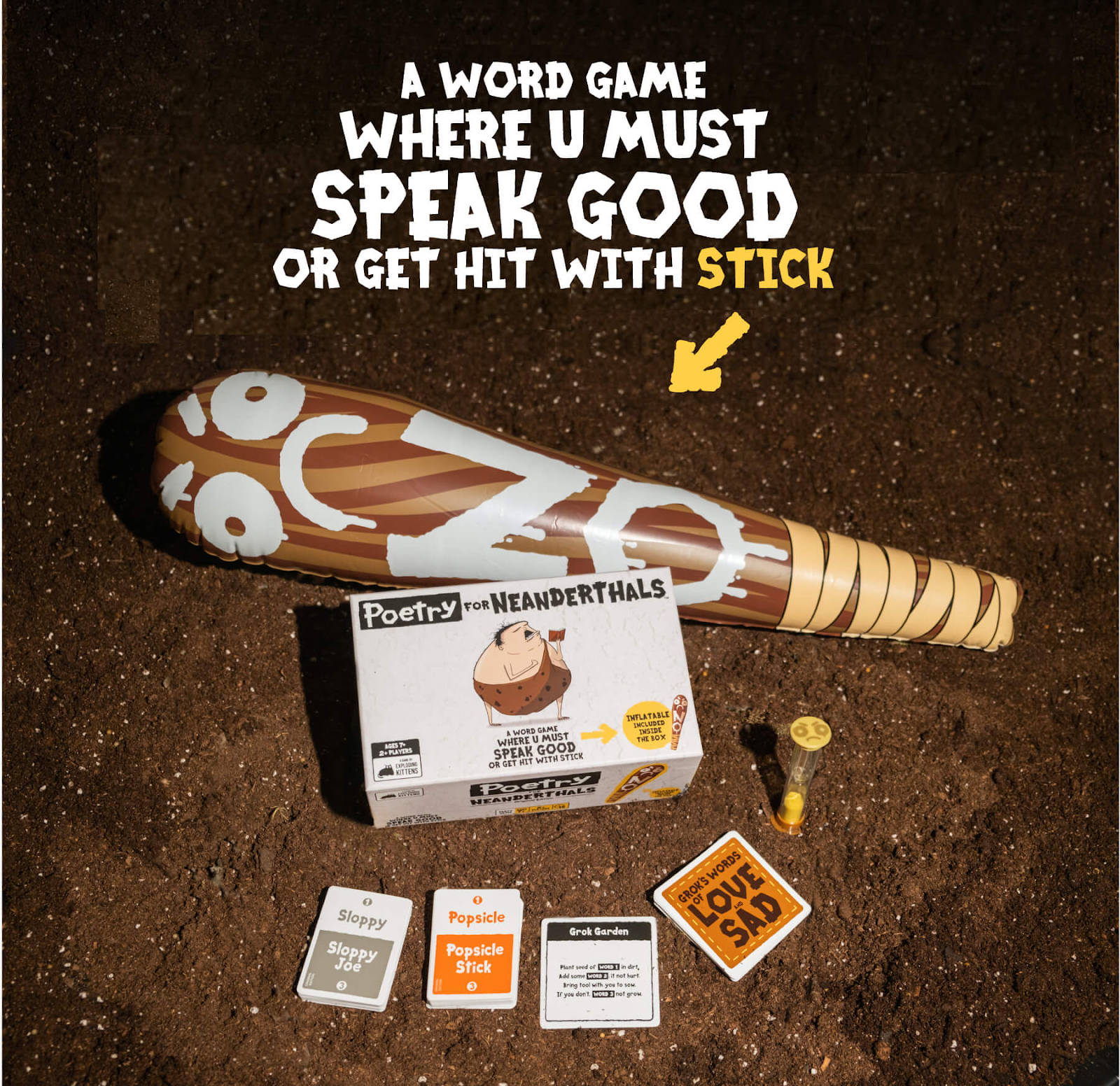
Poetry for Neanderthals, a game designed to be played online during the Covid-19 lockdown
Staying Laser-Focused on Fun and Games
Even though Elan loves the idea of seeing Exploding Kittens as a cartoon one day, he is hesitant to shift his team’s focus from games right now. There are three games that they want to get out this year.
However, ever since Peter Chernin's TCG Capital joined Exploding Kittens as partners last year, they did start having conversations about TV and film.
As a company, Exploding Kittens doesn’t like to talk about revenue and money. “We invest every penny we make back into the company and we would like that to be invisible,” he says.
When their customers write to them about a problem, they send them new cards, no questions asked. “We’re going to treat all of our community like they’re our family, and we don’t want money to be involved in that,” Lee says.
They sold more than 10 million games already, so they have a very large family to take care of.
Since they don’t have any external funders except The Chernin Group, they don’t have any pressure to think and talk about their revenue.
Small amounts attract a larger number of backers
“We needed 10 thousand dollars to exist, we made 10 thousand dollars in seven minutes. At the end of 30 days, we had about 9 million dollars,” Lee says. This also meant that they had to make and send 700,000 copies of the game within 30 months.
They were forced to grow much faster than they had expected, but they managed it without any outside investors for the first five years.
Main Challenges to Growing Fast
Some of their games are made in the US, but most of them are made in China. The manufacturing, labeling, shipping, distributing, selling it to retailers - Elan Lee and his team had no idea about how to run any of these steps. In the last year, they grew from 16 to 35 employees. Now, they are more confident than ever about all of this, but they still have work to do. They’ve set an internal deadline for September 2020 to bring everything in-house.
“We are all about the community and how many people we can get excited.”
Initially, Exploding Kittens relied entirely on word-of-mouth to acquire new customers, and that’s worked very well.
Since last year, they have started investing in creative ad campaigns. Now, they buy ads and experiment with product placement on Amazon and in Target.
The creative part for Lee is figuring out ways to make these ads feel like invitations to join their family.
They used to go to six or seven game conventions per year for two years. It didn’t work for them the way they wanted, so they decided to bring in more creativity to their convention participation.
“What if we built vending machines?” They asked. They built a vending machine with a $1 random item option. In truth, this machine was the team itself in a vending machine costume. This way, they were able to give custom items to their visitors.
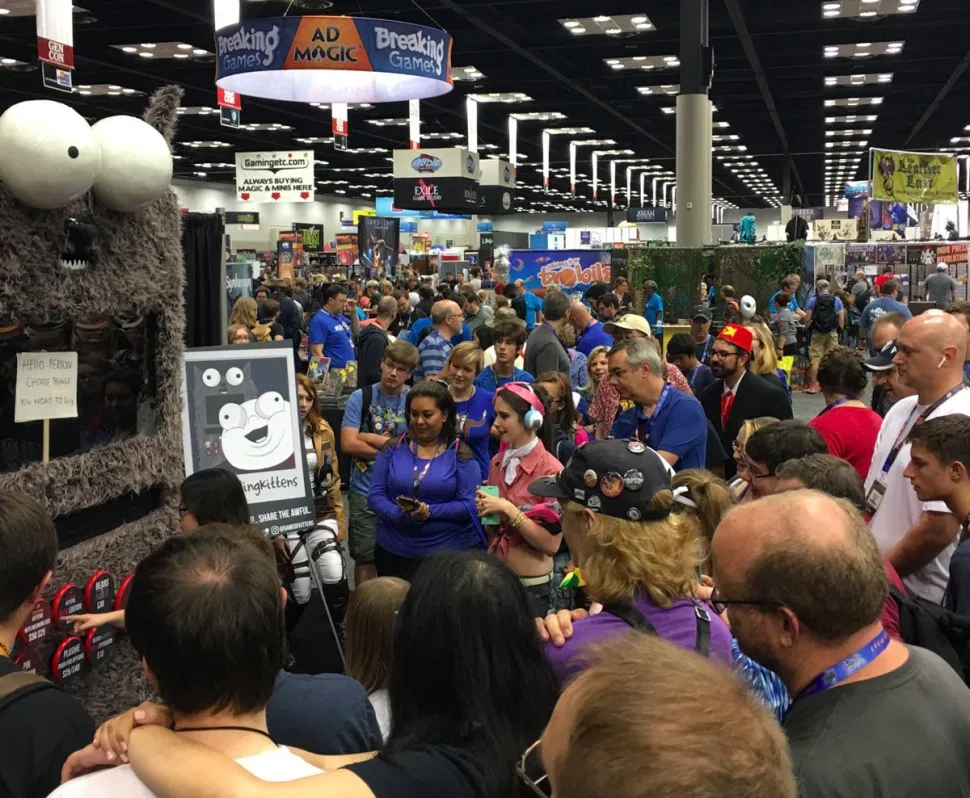

Images courtesy of BoingBoing.net: Exploding Kittens’ vending machine at Comic Con.
For example, if the person was in a COS-play costume, the random item would be a dragon egg. This creative idea led to many social media shares, but Lee says that was not the point for them. “We care about you having a good time more than anything else,” he says.
When we asked him about entrepreneurs from the e-commerce age that he admires the most, Elan gave us two names:
-
Tristan Walker who spent years establishing Bevel, the company that makes shaving products for African-American men before he sold it to Procter & Gamble.
“His initial problem was that there were no shaving products which did not irritate his skin. What is most impressive about this guy is that with this laser-focus, he said ‘Nobody believes me, but there is an audience for this.’ To me, he is the epitome of building that box, finding the solution, and getting it done.”
-
Dan Shapiro who was recently a guest on our podcast. You can read about, watch, or listen to our interview with Dan here.
“He used the internet to put together a skill set that he didn’t have. He learned how to acquire all those things by using the resources available to him to get from point A to B as quickly as possible,” Elan says about Shapiro. “When I grow up, I want to be like Dan.”
And finally, here is the one piece of e-commerce advice Elan Lee had to share with emerging entrepreneurs:
“The decision between a product business and a services business is not binary. Everyone tells you that you have to pick one. What I have finally figured out is that those two things are inextricably linked. You cannot separate them. If you try to, you will just be paying for somebody else to do the other one.”
“When I started a series of marketing companies, I thought I was firmly in the services business. That is not true. I was servicing other people’s products. The product part was still there. It was just that somebody else was making money off of that.”
Now, Elan is in the product business, but he has learned that he must also take care of his product’s customer support or marketing to get the best outcome and profit from his efforts.
Liked this? Check out our other issues here.