Blank Box or Buttons? Which Format Increased Online Donations?

Background & Testing Goal:
When it comes to soliciting charitable donations, there are certain assumed industry “best practices.”
One belief is people will donate more if given the freedom to select their own donation amount.
A previously conducted donation study by the charitable organization, Oxfam, examined this idea and found interesting results.
As an experienced testing team WWF, knew that what works well on one site doesn’t always apply to a different site.
So, the team decided to test the effectiveness of two different donation form formats.
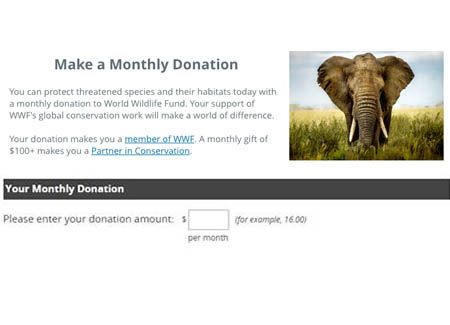
The first format fit the “industry standard.” It asked visitors to input their desired monthly donation amount in a blank box. This unrestrictive, “blank slate” format gave visitors a sense of the wide-open possibilities available for giving.
The blank box option appeared like this:
Version A: Blank Box
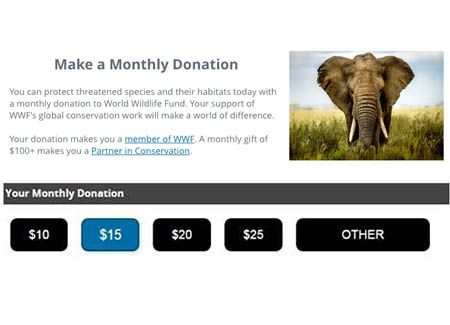
The other format featured a monthly donation table with fixed amounts. Donors could click to select a set monthly donation. The minimum suggested amount was $10. Every subsequent donation button increased in increments of $5.
The $15 contribution button was automatically pre-selected and highlighted in blue. The other buttons were colored in black.
Donors could also click the “Other” button to input an amount not shown.
The clickable button format was meant to provide an easy starting point, encouraging donors to select an amount that felt right for them. It appeared like this:
Version B: Buttons
Difference Between Versions:
Version A – Blank box; users could input the amount they chose to contribute.
Version B – Buttons featuring fixed amounts donors could select. (winner)
Key Performance Indicator (KPI):
Donations
Test Goal:
Increase donations
Traffic Source:
All: direct, search, referral, organic, paid, affiliate, email list, and social
Audience:
Website users interested in wildlife preservation
Organization:
World Wildlife Fund (WWF): Wildlife preservation organization
WINNING VERSION: B
Test Details:
World Wildlife Fund (WWF), conducted this wildly successful donation form test to increase monthly donor contributions.
Hypothesis:
The team suspected providing a default donation amount would encourage more donations than if visitors had to input an undefined amount.
Test Set-up:
To test this assumption, the team split traffic 50/50. A total of 14,489 visitors saw either the version with the blank donation box, or the clickable button.
Donation transactions, revenue, and revenue per visitor were tracked across both versions.
The test ran for one month.
The Real-Life Results:
As expected, letting visitors select a preset donation amount markedly increased donations.
Compared to the losing “blank slate” version, the winning clickable button format lifted
-
Transactions 30.7%
-
Total revenue 15.6%
-
Revenue per visitor 14.7%
All results achieved 95% confidence.
Analysis:
In his book, “The Paradox of Choice – Why More is Less,” psychologist Barry Schwartz argues that eliminating choice reduces anxiety, making it easier for shoppers to decide and, ultimately, purchase.
Researchers at Columbia and Stanford Universities arrived at a similar conclusion in their famous jam study.
In the study, supermarket shoppers were given jam at one of two sampling stations. The first station featured 24 jam flavors. The other offered only six selections.
At the station with 24 flavors, just 3% of shoppers made a purchase. Conversely, at the station with six flavors, an incredible 30% purchased at least one jar of jam!
Clearly, the smaller selection generated more sales. Probably because the larger selection overwhelmed shoppers to the point they weren’t able to decide — so made no decision at all.
The situation was similar in this test.
On the version with the blank box, visitors arriving at the donation page had a vast array of choices.
They first had to decide whether or not they wanted to donate. Those who were in a giving mindset had to next figure how much to donate. This choice was likely difficult for many visitors.
There was no protocol or suggested figure to guide them. The blank box stared them blankly in the face. So, many users chose the easiest option: to not donate all. More choice did not equal more donations.
In contrast, the version that limited choice to a selection of clickable buttons provided the perfect option. Users still had some perceived choice. But, the options were limited and helped guide donors.
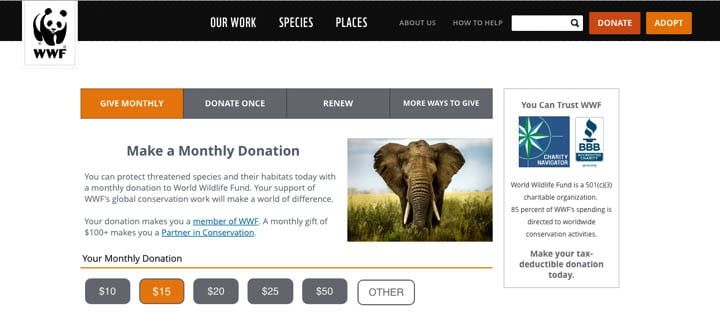
As a testament to WWF’s test, if you go to their donation page today, you’ll see the winning version implemented on their site.
For future testing, we’d be curious to know how the order of the donation amount would impact donations. Would a greater amount of people donate more money if the $25 option was presented first and the suggested amount decreased from there?
We’re also curious to know the optimal starting point for donations. To start, is $10 too little or too much to ask?
Further testing in these areas may be warranted.
Actionable Takeaways:
1. The Paradox of Choice: too much choice can create “analysis paralysis”
Sometimes less truly is more. While choice may be empowering, offering too many options can paralyze your prospects into thinking so much they end up not converting at all.
When offering choice, consider ways to make the selection process easy and not too overwhelming. In this example, providing a default donation amount helped potential donors focus on choosing the right amount – rather than on whether or not to donate.
2. Don’t completely eliminate choice
While too many options can be stressful, no options at all can be discouraging.
If WWF had only offered a $100 monthly donation option, they probably wouldn’t have gotten many donations.
People thrive on having perceived choices. But, those choices need to be limited so a decision can be easily made. Test ways to find the right balance to optimize conversions.
3. Test the best format for your site and audience
Always remember: for every test, there is an equal and opposite result.
Never blindly apply one organization’s finding to your audience or website. Always test for yourself to find the best format that maximizes conversions.
Click Here to Get 6 More Case Studies and the Proven Process We’ve Used to Grow Dozens of Ecommerce Brands