Do Privacy Notices Spook Users or Increase Sign-Ups?

In this case study Delivra, a marketing automation company wanted to know if adding a privacy guarantee, directly below the sign-up button, would give assurance, increasing sign-ups to their free email marketing guide.
Or, conversely, if it would create hesitation, prompting people to question their privacy on the site.Their team tested the two variations of a sign-up form below:
Version A: With privacy guarantee, in little orange text, directly under the red CTA button. The privacy guarantee copy read: “100% privacy guaranteed. Unsubscribe at any time.”
Version B: Without privacy guarantee under the red CTA button
Version A: With Privacy Guarantee
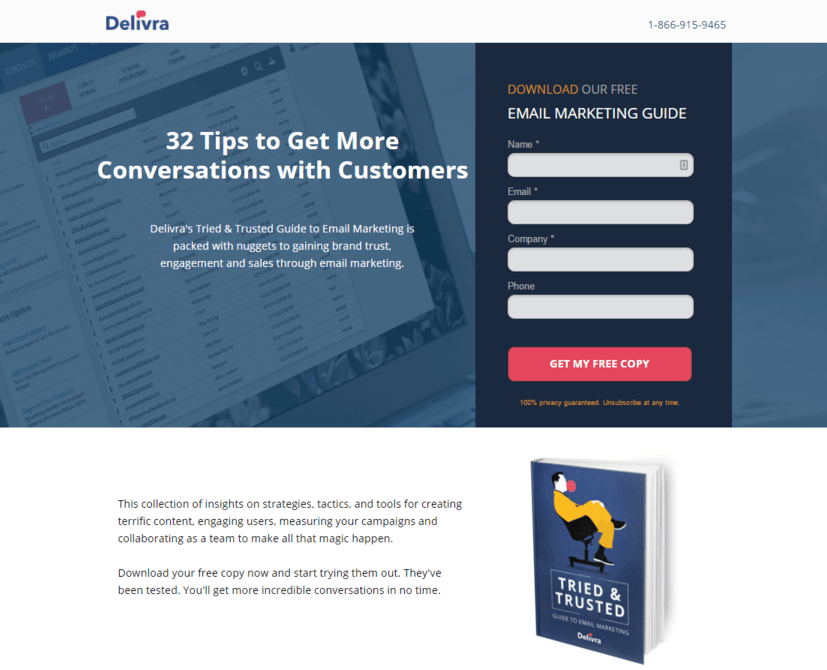
Version B: Without Privacy Guarantee

Drum Roll...So Which Version Won? (Got More Sign-ups)
Version A, with the privacy guarantee message, was the strong winner.
Compared to the version without the privacy guarantee messaging, adding the guarantee increased form submission rates 35%, at 99.9% confidence.
Test Set-up
To accurately determine which format worked best, the team split traffic 50/50.
Traffic was predominantly people working in the B2B space, interested in email marketing software, marketing automation, and lead nurturing tools.
Half of visitors saw the eBook sign-up page with a privacy guarantee directly under the CTA button.
The other half of visitors saw the sign-up form with no privacy guarantee under the main CTA. The form looked like this:
Form completions were tracked across both versions. A form was considered complete when the person filled in all their contact information and pushed the red “get my free copy” button.
The test ran for two weeks on the Unbounce platform.
Analysis
A small change really can make a big difference. Adding just a simple line of text can increase conversions by double digits!
In this test, the messaging likely worked so well because it set expectations and offered readers’ reassurance. Both elements are key for conversions.
Expectations were set and met since potential subscribers were immediately told they didn’t need to worry about their privacy. And they were assured they could unsubscribe at any time.
Preemptively dealing with concerns over privacy and spam is important. After all, these issues are often on top of mind when deciding to sign up for something.
Consider your own process when you contemplate signing-up for a service. What’s the first thing you evaluate before deciding to fill in your personal information?
If you’re like many people, you probably go, “Hmm. . . do I really want to sign-up for this? How much email am I going to get? And what are they going to do with my contact information?”
Addressing these questions upfront gives potential subscribers a clearer sense of the sign-up terms. Users can feel more comfortable giving their contact information because they’re told their privacy will be respected. They can trust the process.
With expectations set, readers don’t have to mull over the decision on whether or not to disclose their personal details. They can just sign up – without hesitation.
According to this book on persuasion, setting expectations can, “create immediate reactions to stimuli so the subject doesn’t even have to think – they just perform the action.”
As usability guru Steve Krug would argue, getting readers to act without thinking is an important objective.
This conversion tactic is known as presupposition.
Presupposition uses words to indicate the offer has already been accepted. For example, if you were trying to sell a new software product to a customer, you’d use presupposition by saying, “should I set you up with it today or tomorrow?” Even though the person hasn’t yet purchased the item, you’re assuming the sale.
In this test, presupposition is used by saying, “unsubscribe any time.” Even though the reader hasn’t yet subscribed, the desire to subscribe is assumed. The copy is crafted to indicate the reader doesn’t even need to think.
As behavioral psychologist Robert Cialdini says, in his book, “Pre-Suasion,” the process of persuasion involves moving people in the direction to get them to give consent before they encounter it.
This test does just that.
It moves readers in the direction of signing up before they have the chance to consider doing otherwise.
Crafting the message in this way also helps preemptively reduce any fears or concerns before they’re even considered. The message gives reassurance that action has already been taken.
The subscriber need not worry about anything; everything’s already taken care of.
However, it is important to note, adding the extra text could have had the opposite effect. It could have increased distraction or increased hesitation since it brought up privacy concerns unprompted. Both of which may have diminished conversions.
As digital marketers, we really never do know how our visitors will react. And, that’s precisely why we test!
Actionable Takeaways
-
Address Expectations at the Onset
Your audience is a lot more likely to convert if they’re immediately clear on the terms and conditions of your offer. Tell users what they will and will not get. If you do so, you’ll get conversions in return.
-
Provide Assurance
Manage expectations by preemptively addressing your audiences’ most important concerns. If you assure them they don’t need to worry about something like privacy, they probably won’t.
However, test the optimal place in your conversion funnel to provide assurance. Attempting to instil confidence too early in the process might create unnecessary suspicion.
-
Use Presupposition to be Persuasive
Your persuasive powers increase when you craft copy so the reader has no choice, but to accept your proposition.
When possible, frame your message so compliance with your request is implicit — and not up for debate.
Want more case studies like this one?
Click Here for 6 More Case Studies, and the Proven Process Used by Dozens of Ecommerce Brands